
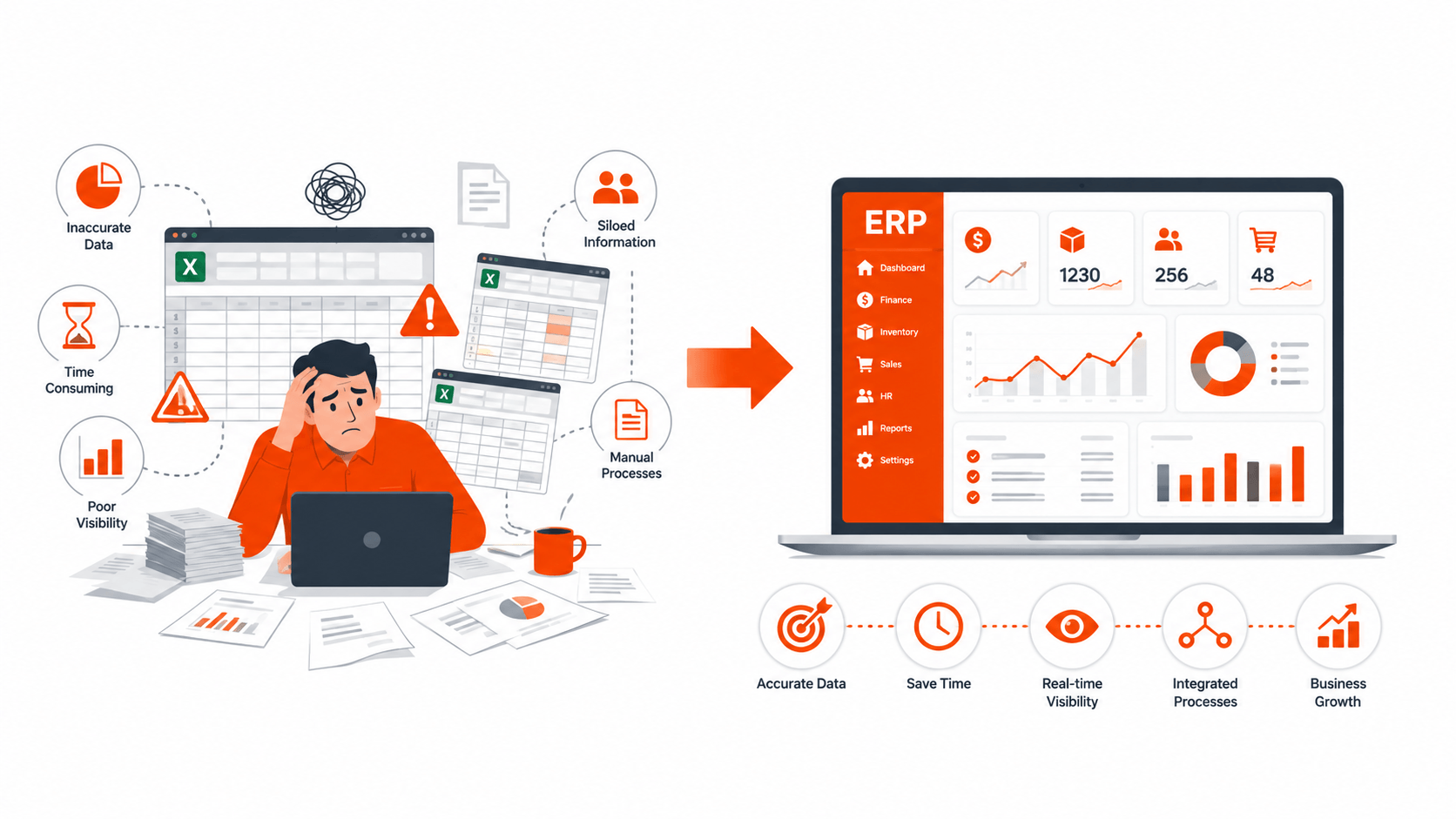
Spreadsheets are where most businesses start, and for good reason. They are cheap, familiar, and flexible enough to handle almost anything when you are small. But there is a point where spreadsheets stop being a tool and start being a trap. The problem is that most business owners do not realize they have crossed that line until something breaks badly enough to force the issue.
If you are running your operations on a patchwork of Excel files, Google Sheets, and manual workarounds, here are the signs that you have outgrown that setup and need something built for the scale you are operating at.
1. You Have Multiple Versions of the Same Spreadsheet
This is the most common early warning sign. Someone in finance has “RevenueTrackingv4FINAL.xlsx.” Someone else in sales has “RevenueTrackingv4FINAL_UPDATED.xlsx.” Neither of them matches the version the managing director is looking at.
When you cannot agree on which version of a spreadsheet is the source of truth, you have a data integrity problem. Decisions get made on outdated numbers. Reports conflict with each other. Trust in the data erodes, and people start asking for the same information three different ways just to make sure they are getting something accurate.
An ERP system maintains a single source of truth. When someone updates a record, everyone sees the update. There is no v4_FINAL. There is just the current state of your business.
2. You Are Entering the Same Data in More Than One Place
A customer places an order. Someone types the order details into a sales spreadsheet. Someone else manually creates an invoice in a different spreadsheet. Someone else updates the inventory count in yet another spreadsheet. The same customer name, the same order number, the same product, typed three times by three different people.
This is not just inefficient. It is dangerous. Every manual entry is an opportunity for a typo, a missed row, or a transposed number. Multiply that across hundreds of transactions and the error rate becomes a real cost to your business.
ERP systems eliminate duplicate data entry. One action updates everything connected to it. A sale updates inventory, generates an invoice, and adjusts financial reporting simultaneously.
3. You Cannot Get a Real-Time View of Your Business
You want to know how much revenue you have generated this month. You want to know your current inventory levels. You want to know which invoices are overdue. In each case, someone has to pull data from multiple spreadsheets, reconcile the differences, and build a summary. By the time you get the report, the data is already hours or days old.
Running a business on stale data is like driving while looking in the rearview mirror. You can see where you have been, but you cannot see what is ahead.
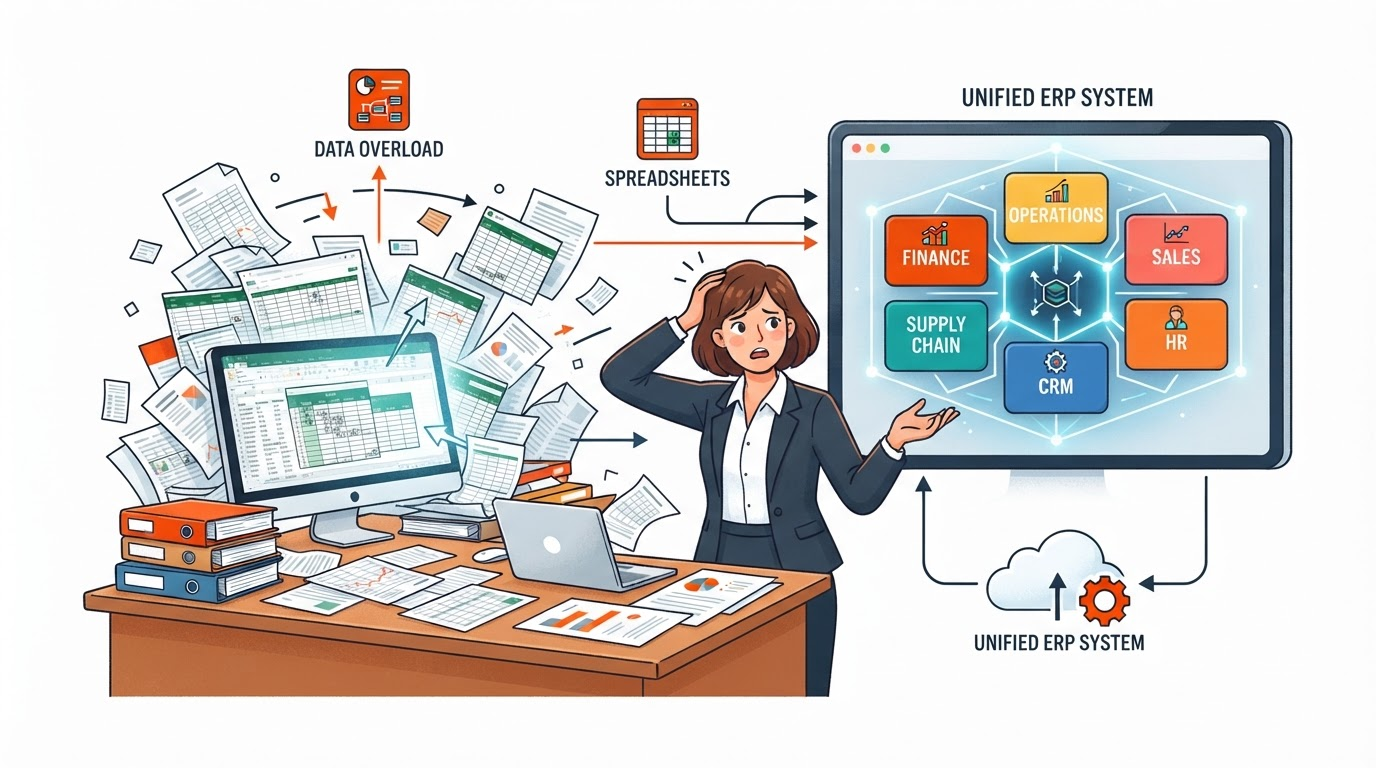
Research by McKinsey has shown that businesses with real-time data access make faster and more accurate decisions. An ERP system gives you dashboards that reflect the current state of your operations, not a snapshot from last Thursday.
4. Onboarding New Employees Takes Too Long
A new hire joins your team. To get them up to speed, you have to explain where every spreadsheet lives, which ones they need access to, how the formulas work, what the color coding means, and which tabs are actually used versus which ones are legacy experiments nobody has deleted.
This is a sign that your institutional knowledge lives in people’s heads rather than in your systems. When a key person goes on leave, gets sick, or leaves the company, that knowledge goes with them.
An ERP system has defined workflows and processes built into the software. New employees learn the system, not someone’s personal spreadsheet logic. That makes onboarding faster and reduces the risk of losing critical knowledge when people move on.
5. You Have Had a Spreadsheet Catastrophe
You know the one. Someone accidentally deleted a column of formulas. Someone sorted one column without selecting the entire row, scrambling months of data. Someone overwrote the file with an older version. The file got corrupted and the last backup is two weeks old.
If this has happened to you, you already know the panic. Hours or days of work lost. Financial reports that suddenly do not add up. A scramble to reconstruct what happened and figure out what the real numbers should be.
Spreadsheets have no meaningful audit trail. You cannot easily see who changed what, when, and why. ERP systems track every change, who made it, and allow you to reverse errors without rebuilding from scratch.
6. Your Reporting Takes More Time Than Your Doing
If your finance team spends the first two weeks of every month building reports for the previous month, you have a structural problem. The purpose of data is to inform decisions. If the effort required to extract insights from your data exceeds the value of those insights, your system is working against you.
An ERP system automates reporting. Monthly closes, inventory summaries, sales performance, and financial statements can be generated in minutes rather than days. Your team spends time analyzing the numbers instead of chasing them.
7. You Are Adding Headcount Just to Handle Administrative Work
You hired more people, but instead of driving revenue, they are managing data entry, reconciling spreadsheets, and fixing errors. Your administrative overhead is growing faster than your revenue.
This is a scalability problem. A business running on spreadsheets can only scale its operations by scaling its manual labor. An ERP system lets you scale operations without proportionally scaling administrative staff. That is the difference between growing profitably and growing yourself into a corner.
8. You Cannot Track Inventory Accurately
You think you have 200 units of a product in stock. A customer orders 50. Someone checks the warehouse and finds 30. Now you have a backorder, a frustrated customer, and a spreadsheet that says you have 200 units that do not exist.
Inventory discrepancies are one of the most expensive consequences of spreadsheet-based operations. They lead to stockouts, overstocking, lost sales, and wasted capital. According to a study by the IHL Group, retail inventory distortions including out-of-stocks and overstocks cost businesses globally over a trillion dollars annually.
An ERP system tracks inventory in real time. When a sale is made, inventory adjusts. When stock arrives, it is logged. When levels drop below a threshold, the system flags it. No manual counting, no guessing, no embarrassing stockouts.
9. Compliance and Auditing Are Becoming a Nightmare
Whether you are dealing with KRA requirements, industry regulations, or internal policies, audits are painful when your data lives in spreadsheets. Auditors want to see complete, traceable records. They want to know who approved what and when. They want to see that financial data has not been tampered with.
Spreadsheets are almost impossible to audit properly. Anyone can change anything, and there is no reliable way to track those changes after the fact. ERP systems maintain detailed audit logs, access controls, and approval workflows that make compliance straightforward and audits survivable.
10. You Are Avoiding Growth Because the Admin Would Kill You
This is the final sign and the one that should scare you the most. You have an opportunity to take on a bigger client, open a new location, or add a product line, and you hesitate because your current systems cannot handle the additional complexity. You are turning down growth not because the market is not there, but because your operations cannot support it.
That is the moment where spreadsheets stop being a scrappy startup habit and start being an active constraint on your business.
But Is an ERP System Not Too Expensive?
This is the most common objection, and it is worth addressing directly.
Yes, ERP systems cost more than a Google Sheet. But the cost of spreadsheets is not zero. It shows up in the hours your team spends on manual data entry, the revenue lost to errors and stockouts, the delays in reporting, and the opportunities you miss because you cannot respond fast enough. Those costs are real. They just do not show up on a single invoice.
Modern ERP systems are also more accessible than they used to be. Cloud-based solutions have eliminated the need for expensive on-premise infrastructure. Subscription pricing means you pay for what you use rather than making a massive upfront investment. Solutions like Odoo and ERPNext offer modular pricing that lets you start with the functions you need and add more as you grow.
What to Do Next
If you recognized your business in three or more of the signs above, you should seriously be evaluating ERP options. Not next year. Now. The longer you wait, the more expensive the transition becomes, because the volume of data you have to migrate and the number of processes you have to restructure only grow over time.
If you are not sure where to start, that is where we come in. At Uppfy, we help businesses assess their current systems, identify the gaps, and implement ERP solutions that fit their actual needs rather than selling them the most expensive package on the shelf. You can learn more about our ERP and CRM services, or simply reach out and we will have a conversation about where you are and what makes sense for your business.
Spreadsheets got you this far. That is worth respecting. But they will not get you where you are going.