

Something shifted in the last year that most businesses haven’t caught onto yet. People stopped searching the way they used to. Instead of typing keywords into Google and scrolling through ten blue links, they started asking ChatGPT, Perplexity, and Gemini full questions and expecting complete answers. That shift changed what it means to be “found online,” and it created an entirely new discipline: Generative Engine Optimization, or GEO.
If you run a business and your digital strategy still begins and ends with traditional SEO, you are leaving visibility on the table. Here is what GEO is, how it works, and why treating it as just an extension of SEO will cost you in 2026.
What Is GEO (Generative Engine Optimization)?
GEO is the practice of optimizing your content and online presence so that AI-powered search engines mention your brand, cite your pages, and recommend your services when users ask them questions.
Traditional SEO focuses on ranking in a list of results. Generative Engine Optimization focuses on being included in a generated answer. That distinction matters more than it sounds.
When someone asks Perplexity “What is the best digital agency in Nairobi for web development and SEO?”, they are not looking at a page of links. They are reading a synthesized paragraph that pulls from multiple sources and names specific businesses. If your agency is not one of those sources, you do not exist in that answer. No click, no impression, no second chance.
Research from Princeton, Georgia Tech, and IIT Delhi published a study on Generative Engine Optimization that formally introduced the concept and showed that specific content strategies can significantly increase visibility in AI-generated outputs. That paper validated what many in the industry had already started noticing: the rules of visibility were being rewritten.
How GEO Differs from SEO
At a glance, GEO and SEO look similar. Both involve creating content, building authority, and structuring your site so machines can understand it. But the mechanics diverge quickly.
The output format is different: SEO competes for position one on a results page. GEO competes for inclusion in a narrative. AI engines do not just list your page. They paraphrase it, combine it with other sources, and present it as their own answer. Your job is to make your content the most quotable, cite-worthy source on a given topic.
The signals that matter are different: Google’s algorithm relies heavily on backlinks, domain authority, and click-through rates. Generative engines weight factual clarity, direct answers, structured data, and source credibility. A page that ranks well on Google might never get cited by an AI model if it buries its key points in fluff or lacks clear attribution.
Query intent shifts: SEO keywords tend to be short and transactional. GEO queries are conversational and specific. Someone is not typing “SEO agency Kenya.” They are asking “Which SEO agency in Kenya can help my business show up in AI search results?” That is a fundamentally different content challenge.
Citation behavior is new territory: AI engines cite sources. Getting cited requires a different approach than getting clicked. Your content needs to be structured so that an AI model can extract a clean, factual statement and attribute it to you. That means fewer vague claims and more specific, verifiable statements.
SEO vs GEO at a glance
- Goal: Traditional SEO ranks in search results; GEO aims to be cited in AI-generated answers.
- Query style: SEO optimizes for keywords; GEO targets conversational questions.
- Key signals: SEO leans on backlinks, domain authority, and CTR; GEO prioritizes factual clarity, structured data, and source credibility.
- Content format: SEO often favors long-form keyword coverage; GEO favors direct, quotable, well-structured answers.
- Competition: SEO competes with other websites; GEO competes with other sources AI models can cite.
- Measurement: SEO tracks rankings and organic traffic; GEO tracks brand mentions in AI outputs and referral traffic from AI platforms.
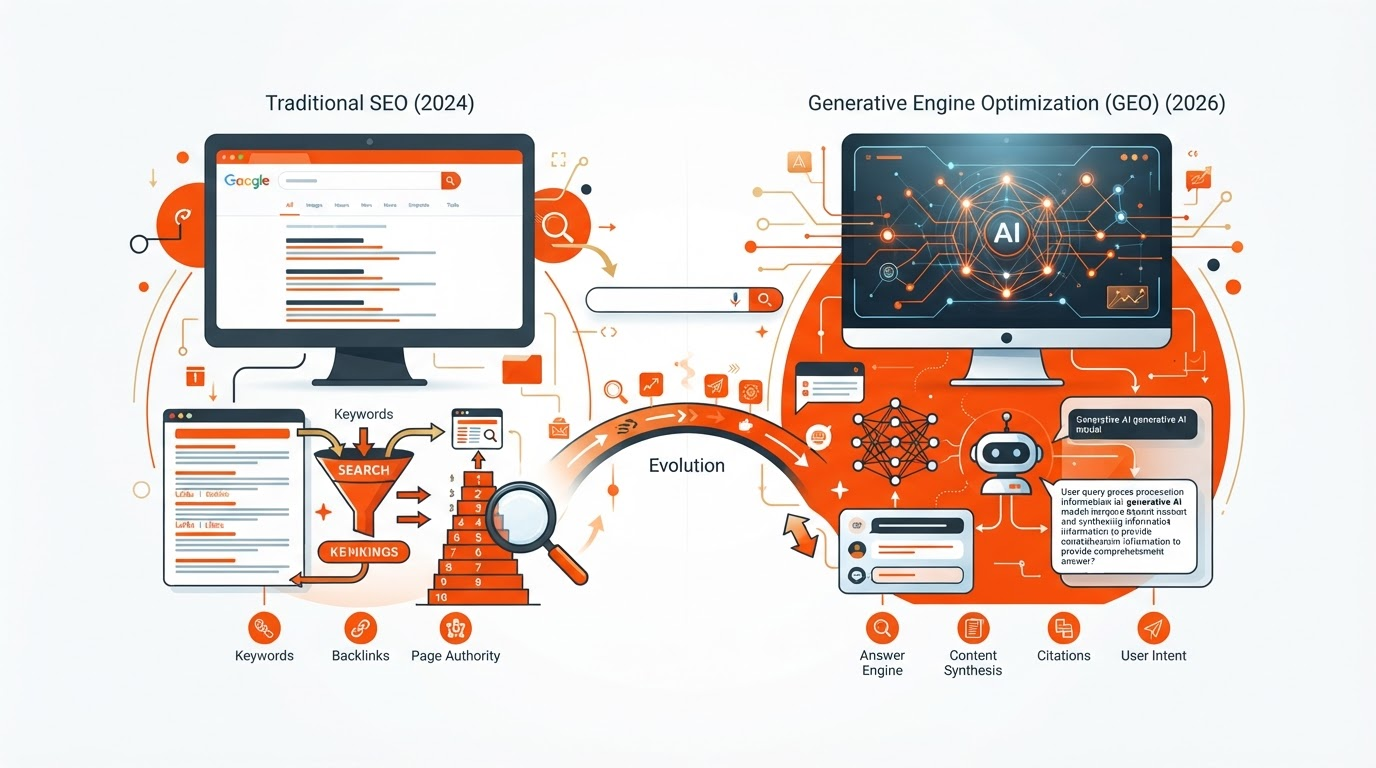
Why GEO Matters in 2026
The numbers tell the story. A recent survey by the Reuters Institute found that younger demographics increasingly default to AI assistants over traditional search engines for product research and service recommendations. Google’s own AI Overviews now appear at the top of a growing percentage of search results, meaning even Google users are reading AI-generated summaries before they see your carefully optimized page.
In Kenya and across Africa, the shift is accelerating. Mobile-first users who never developed deep loyalty to Google’s link-based interface are finding it natural to ask an AI assistant for recommendations. When a business owner in Mombasa asks Gemini where to find a reliable ERP consultant, your GEO strategy determines whether your name appears in that answer.
The businesses that invest in GEO now will have a compounding advantage. AI models develop citation patterns. Once a source is recognized as authoritative and frequently cited, it tends to be cited again. Early movers build a moat.
How to Start Optimizing for Generative Engines
You do not need to abandon SEO to do GEO well. The two disciplines overlap significantly. But you do need to add specific practices that traditional SEO does not cover.
Write in direct, quotable statements: AI models extract and rephrase content. If your page says “We offer comprehensive digital solutions tailored to your unique business needs,” an AI model has nothing specific to work with. If it says “Uppfy provides web development, SEO, and AI automation services for businesses in Kenya,” that is a statement an AI engine can cite and attribute.
Structure your content with clear headings and schema markup: Schema.org markup helps AI models understand what your page is about and what kind of entity you are. Organization schema, service schema, and FAQ schema are particularly valuable for GEO because they give AI engines structured data they can extract with confidence.
Build entity-level authority: AI models do not just evaluate pages. They evaluate entities. Your business needs a consistent, verified presence across knowledge bases. That means claiming and maintaining your Google Business Profile, ensuring your Wikipedia or Wikidata entries are accurate if you have them, and being mentioned in reputable directories and publications that AI models crawl.
Answer specific questions directly: Every page on your site should answer at least one question so clearly that an AI model would have no reason to look elsewhere. Put the answer near the top of the section. Do not make the model dig for it.
Monitor your AI visibility: Tools like Perplexity and Peec AI let you search for your brand and see whether and how AI engines reference you. Make this a regular practice, just like checking your search rankings.
Combine SEO and GEO: If you want a structured approach to both, our SEO and GEO service outlines how we help businesses optimize for traditional search and AI-generated answers simultaneously.
The Bottom Line
GEO is not a replacement for SEO. It is an expansion of what it means to be visible online. SEO gets you on the list. GEO gets you in the answer. In 2026, the answer is where the attention is.
The businesses that treat Generative Engine Optimization as a separate, intentional strategy rather than an afterthought will be the ones showing up when customers ask AI engines for recommendations. The ones that ignore it will still be competing for position five on a results page that fewer people are reading.
If you want to understand how your current digital presence performs in AI search and what it would take to improve it, reach out to Uppfy. We work with businesses across Kenya and beyond to build visibility that works in both traditional search and generative engines.