
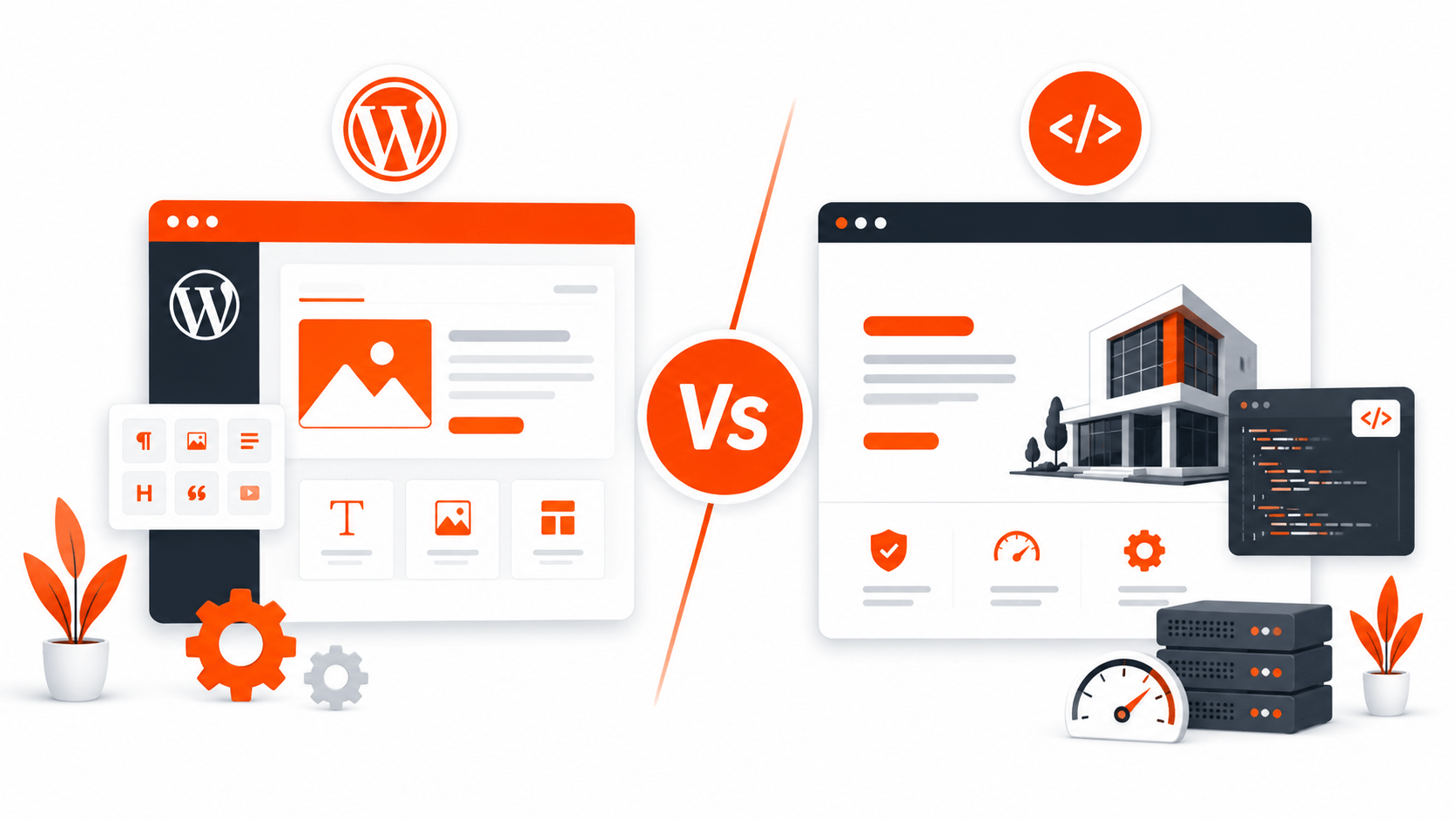
This is one of the most common questions we get from business owners, and it is also one of the most poorly answered questions on the internet. Most articles on this topic are written by people who have already picked a side. WordPress agencies will tell you WordPress is the only sensible choice. Custom dev shops will tell you WordPress is a toy and you need something built from scratch.
The real answer is less exciting but more useful: it depends on your business, your budget, your growth plans, and what you actually need your website to do. Here is an honest breakdown of WordPress vs a custom-built website in 2026.
What WordPress Does Well
WordPress powers roughly 43% of all websites on the internet according to W3Techs, and that dominance exists for a reason.
Speed to launch: You can have a functional WordPress site live in days, not weeks. Themes and page builders like Elementor let you build out layouts without writing code. For a business that needs a web presence immediately, that is a genuine advantage.
Cost at the entry level: WordPress itself is free. Hosting is cheap. Themes cost between $30 and $100. A small business can get a professional-looking site for a fraction of what custom development would cost.
Plugin ecosystem: Need a contact form, an SEO tool, a booking system, or ecommerce functionality? There is a plugin for that. The WordPress plugin directory has over 60,000 options. That ecosystem means you can add functionality without hiring a developer for every single feature.
Content management: The WordPress admin interface is familiar. Most marketing teams and content managers know how to use it. Training time is minimal.
SEO readiness: WordPress works well with tools like Yoast SEO and Rank Math, making on-page SEO accessible even for non-technical users.
Where WordPress Struggles
The same things that make WordPress flexible also create problems as you grow.
Performance: WordPress sites are heavy out of the box. A typical WordPress install loads dozens of CSS and JavaScript files, makes multiple database queries per page, and depends on plugins that each add their own overhead. You can optimize this, but you are fighting the architecture. A well-built custom site will almost always load faster than a well-optimized WordPress site with equivalent functionality.
Security: WordPress is the biggest target on the internet. Its market share makes it a high-value target for automated attacks. Plugins are the weakest link. A report by Sucuri consistently shows that plugin vulnerabilities account for the majority of WordPress infections. Keeping everything updated is non-negotiable, and many business owners do not.
Scalability: WordPress works fine for a site with a few hundred pages and moderate traffic. It starts to creak when you need complex data relationships, custom user workflows, multi-tenant architectures, or high-volume transactional systems. You can extend WordPress with custom code, but at some point you are building a custom application inside a framework that was designed for blogging.
Design limitations: A theme can get you 80% of the way there. The last 20% is where you spend hours fighting the theme’s assumptions, writing custom CSS overrides, and installing yet another plugin to handle something the theme was not built for. That 20% often takes longer than building it from scratch would have.
What Custom-Built Websites Do Well
A custom-built website is one developed specifically for your business using a modern framework like Next.js, Laravel, or similar technologies. Nothing is pre-built. Everything is intentional.
Performance by design: A custom site loads only what it needs. No unnecessary scripts, no bloated plugin chains, no database queries that exist because a theme decided to load your entire post history on every page. Speed is not an afterthought. It is built into the architecture.
Tailored functionality: You are not adapting your business processes to fit a plugin. You are building the exact features your business needs, in the way your business needs them. That matters more than most people realize. When your website matches how your business actually operates instead of forcing you to work around a plugin’s limitations, everything runs smoother.
Security: A custom site is not immune to attacks, but it is a much smaller target. There is no public vulnerability database for your specific codebase. No automated bot is scanning for your version number. You control the attack surface.
Scalability: Custom architectures are designed to grow with your business. If you need to add a customer portal, integrate with an ERP system, or handle thousands of concurrent transactions, a custom codebase can be engineered for that from the start.
Competitive differentiation: When your website looks and works exactly like every other WordPress site in your industry using the same popular theme, you blend in. A custom build gives you a visual and functional identity that no competitor can replicate by installing the same template.
Where Custom Builds Struggle
Cost: A custom-built website requires designers, developers, and project managers working for weeks or months. That costs more than a WordPress site. There is no way around that.
Time: A custom build takes longer. If you need a site next week, WordPress is your friend. If you need a site that is engineered for the next five years, custom is worth the wait.
Ongoing maintenance: You cannot just update a plugin. Changes require a developer. That means you need either an in-house team or a reliable agency partner. If you are the kind of business owner who wants to log in and tweak things yourself, custom development will frustrate you.
How to Decide
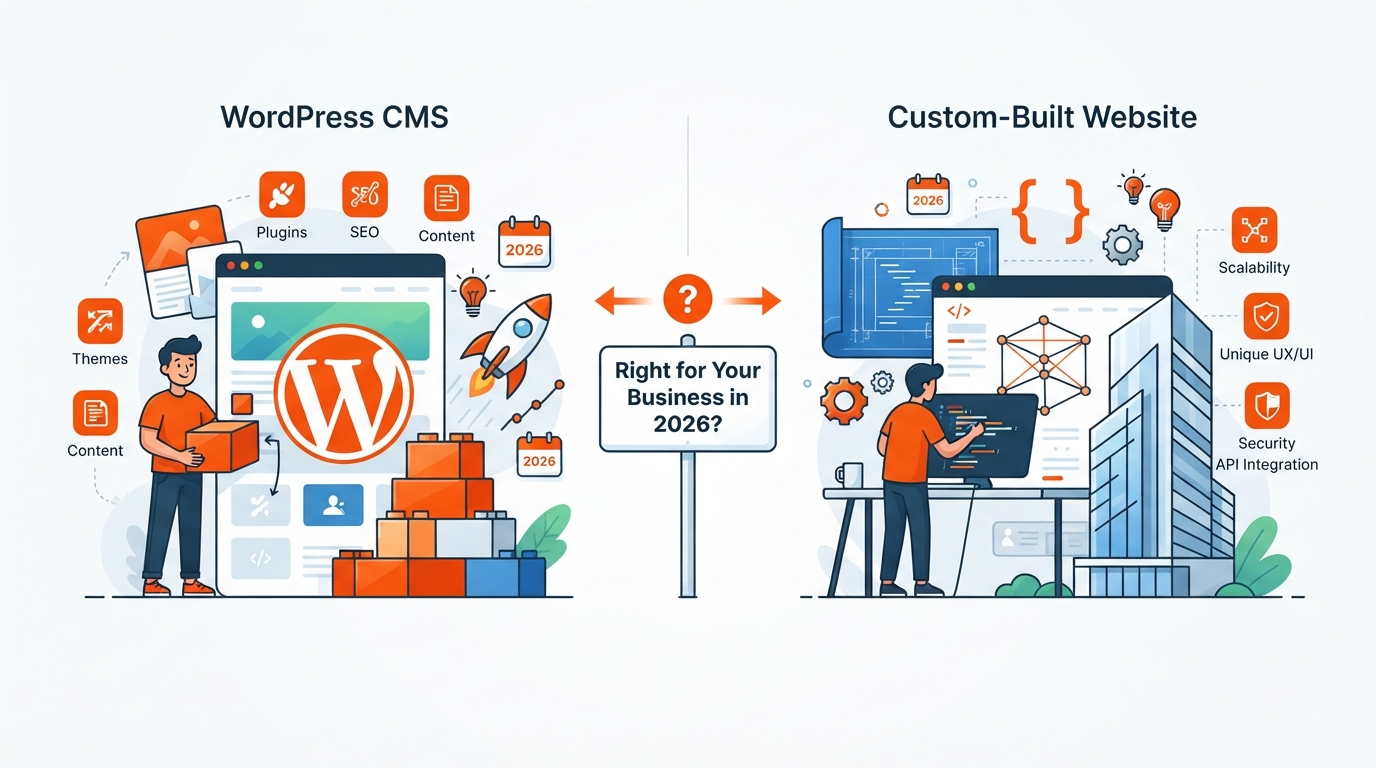
The decision comes down to a few honest questions about where your business is right now.
Choose WordPress if
- You are a startup or small business that needs a professional web presence quickly and affordably.
- Your requirements are relatively standard: informational pages, a blog, maybe a simple ecommerce store.
- You or your team want to manage content in-house without relying on a developer for every update.
- Your budget is under $1,200 for the initial build.
Choose custom-built if
- You need specific functionality that WordPress plugins cannot handle well or at all.
- Your business processes are unique enough that adapting them to off-the-shelf tools creates more problems than it solves.
- Performance is a priority, either because of traffic volume or because your industry demands it.
- You are building a platform, not just a website.
- You have the budget and the timeline to invest in something built to last.
Choose a hybrid if
- You are somewhere in between. Many businesses start with WordPress and migrate to a custom build when they outgrow it.
- Others run WordPress for their marketing site and a custom application for their customer portal.
- There is no rule that says you have to pick one and commit forever.
A Common Mistake
The mistake we see most often is businesses choosing WordPress because it is cheaper upfront, then spending months and significant money trying to make it do things it was not designed for. By the time they have added twelve plugins, custom post types, a membership system, and an integration with their CRM, they have spent more than a custom build would have cost, and the site still performs poorly.
If you know from the start that you need complex functionality, custom integrations, or high performance, save yourself the detour. Build it right the first time.
What We Recommend
At Uppfy, we work with both. We build WordPress sites for businesses that need a fast, cost-effective web presence, and we build custom solutions for businesses that need more than a CMS can offer. The right choice depends on your situation, not ours.
If you are trying to figure out which direction makes sense for your business, talk to us about web development. We will give you an honest assessment even if it means recommending the cheaper option. The best website for your business is the one that actually serves your business, not the one that generates the largest invoice.